When sourcing permanent magnets for motors, sensors, new energy systems, smart appliances, or precision automation, the neodymium magnet manufacturer you choose determines far more than just the unit price. It shapes your product quality, supply chain resilience, delivery reliability, and ultimately your end customers’ experience.
Neodymium iron boron (NdFeB) magnets are the strongest commercially available rare-earth permanent magnets — and the market for them is crowded. Hundreds of suppliers compete on price, but only a fraction have the engineering depth, production scale, and quality infrastructure to serve demanding B2B applications consistently.
This guide from Huajin Magnets — a sintered NdFeB manufacturer with 15+ years of production experience, a 10,000㎡ integrated factory, and 100+ employees — breaks down the six critical dimensions every procurement engineer and sourcing manager must evaluate before committing to a supplier.
Why Choosing the Right Neodymium Magnet Manufacturer Matters
The global NdFeB magnet market is projected to exceed $30 billion by 2030, driven by EV motors, wind turbines, robotics, and consumer electronics. This surge attracts both established factories and small informal workshops, making supplier evaluation more critical — and more difficult — than ever.
The consequences of a wrong sourcing decision compound quickly:
- Coating failure on delivery batch → assembly line stoppage, rework costs
- Dimensional out-of-tolerance → defective finished products, customer returns
- Magnetic decay under heat → field failures in motors and sensors
- Supply disruption from an undersized workshop → production schedule collapse
A qualified neodymium magnet manufacturer eliminates these risks through verifiable systems — not promises. Here is how to tell them apart.
6 Criteria to Evaluate a Neodymium Magnet Manufacturer
1. Custom Production Capability: The Primary Benchmark
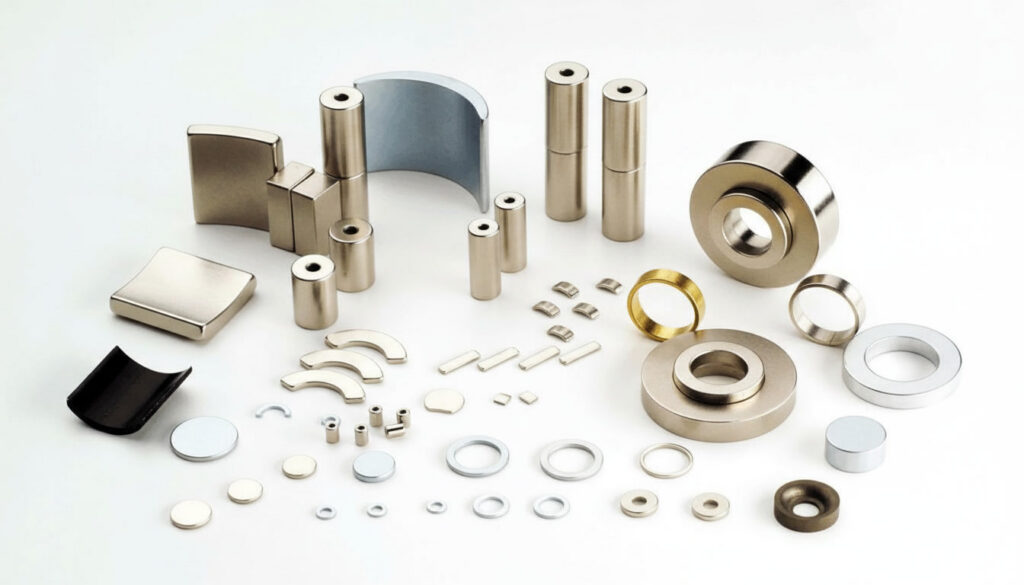
Standard catalog magnets rarely satisfy the exacting requirements of modern industrial applications. Motor designers need precise flux density profiles. Sensor manufacturers demand sub-0.05mm dimensional tolerances. Robotics engineers require complex geometries — arc segments, rings, countersunk holes — that only purpose-built tooling can produce.
A professional neodymium magnet manufacturer develops custom neodymium magnets directly from your technical drawings, CAD files, or application briefs. Key customization dimensions include:
| Customization Parameter | Examples |
|---|---|
| Grade / magnetic performance | N35 → N52; temperature grades N / M / H / SH / UH / EH |
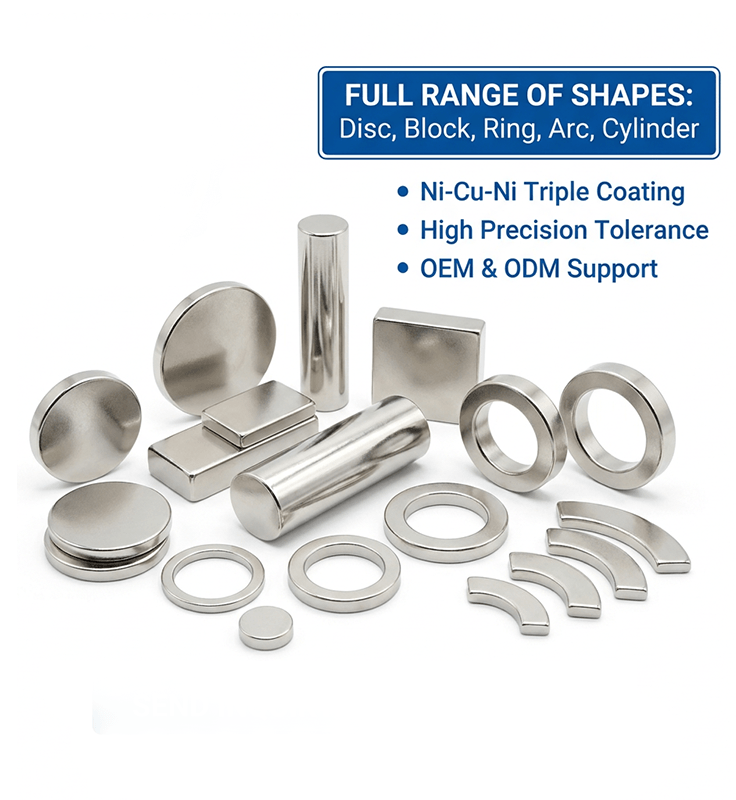
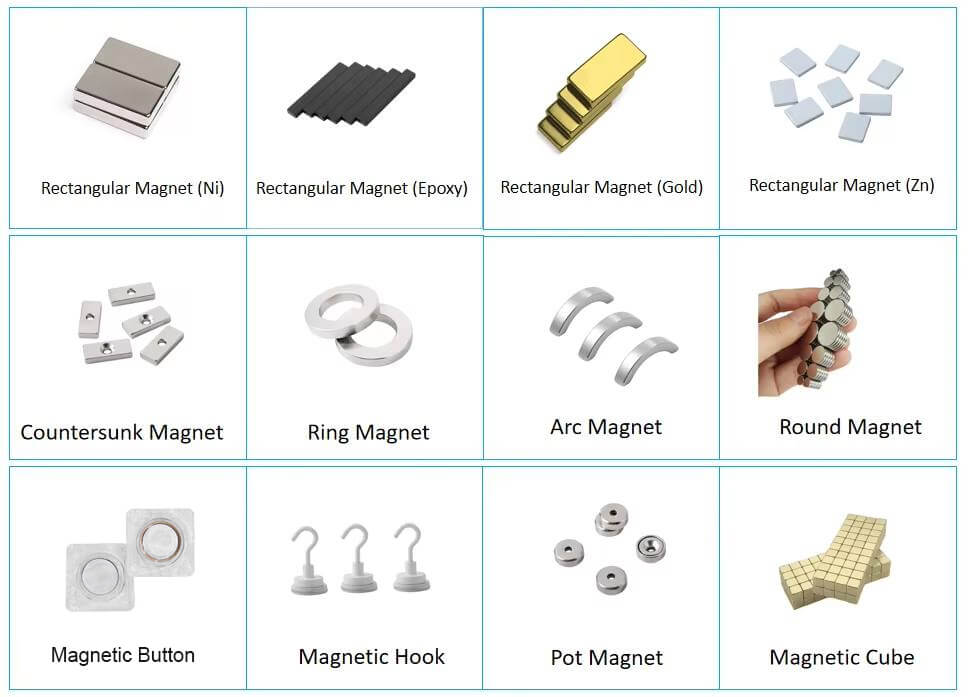
| Geometry & dimensions | Disc, block, ring, arc segment, countersunk, irregular shape |
| Dimensional tolerance | Standard ±0.05mm → precision ±0.02mm or tighter |
| Surface coating | Ni-Cu-Ni, Zn, epoxy, gold, parylene, PTFE, passivation |
| Magnetization direction | Axial, diametral, multi-pole, radial, customized orientation |
| Temperature resistance | Up to 230°C with EH-grade material |
Manufacturers with genuine customization capabilities eliminate costly mismatches between magnet specifications and assembly requirements, reducing defect rates and downstream warranty claims.
What to verify: Request samples from previous custom orders with geometries similar to yours. Request the tolerance report and magnetization curve data for that batch.
2. OEM Processing Maturity: Essential for Brand Owners
If your business requires private-label magnets, exclusive specifications, or confidential custom processes, your neodymium magnet manufacturer must operate a mature OEM neodymium magnet production system — not just claim to offer OEM.
A qualified OEM supplier provides:
- Private mold development with mold ownership options
- NDA-protected drawing confidentiality — your specifications are never shared
- Independent batch management — your production runs are isolated from standard catalog orders
- End-to-end process traceability from raw material lot to finished shipment
- Complete documentation package per order: CoA, dimensional inspection report, magnetic performance test report, RoHS/REACH compliance certificate, batch production records
The critical differentiator is documentation discipline. Informal workshops may produce acceptable samples but cannot deliver batch-consistent quality with verifiable traceability — a dealbreaker for brand owners managing product liability risk.
What to verify: Request a sample documentation package from a previous OEM order. Confirm whether their NDA is enforceable under your jurisdiction.
3. Wholesale & Bulk Supply Capacity: Consistency at Scale
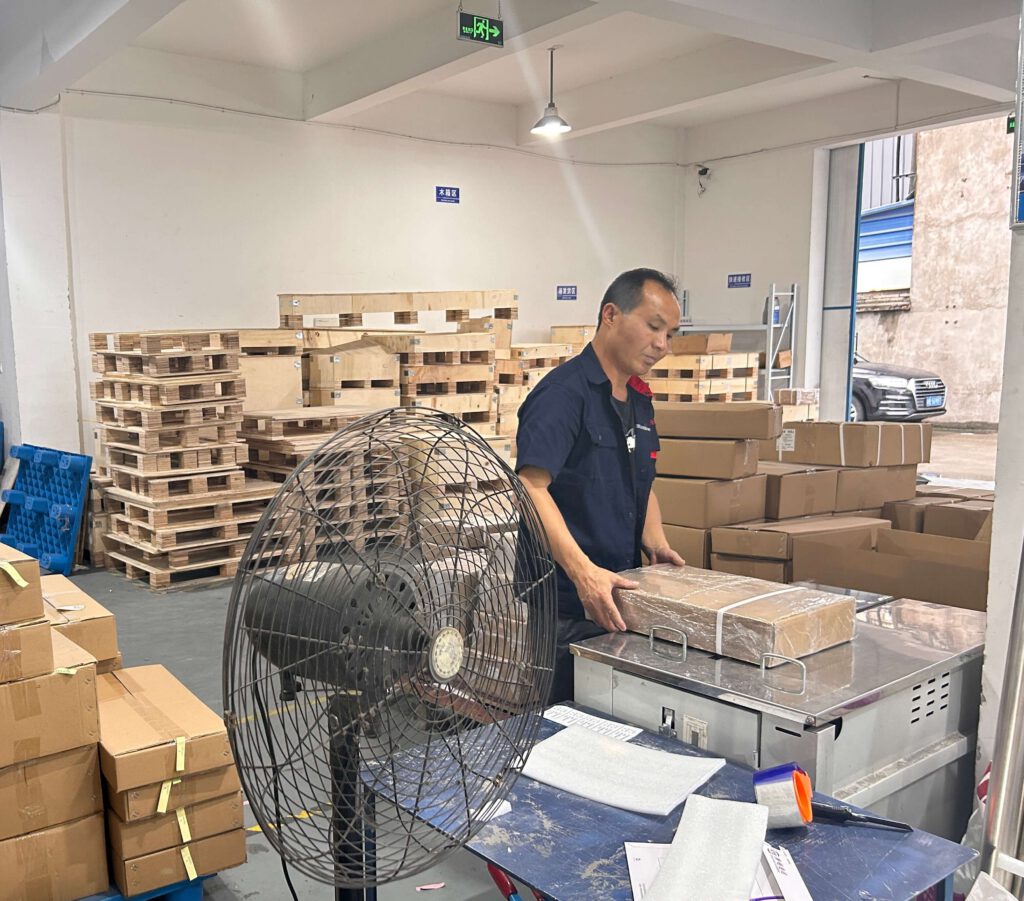
For procurement teams managing high-volume production schedules, a neodymium magnet manufacturer‘s supply capacity is as important as product quality. Small workshops frequently offer competitive sample pricing but collapse under sustained volume pressure — leading to delayed shipments, undersized batches, and inconsistent quality across production runs.
Established manufacturers supporting wholesale neodymium magnets and bulk neodymium magnets procurement maintain:
| Capability | Benchmark for Serious Manufacturers |
|---|---|
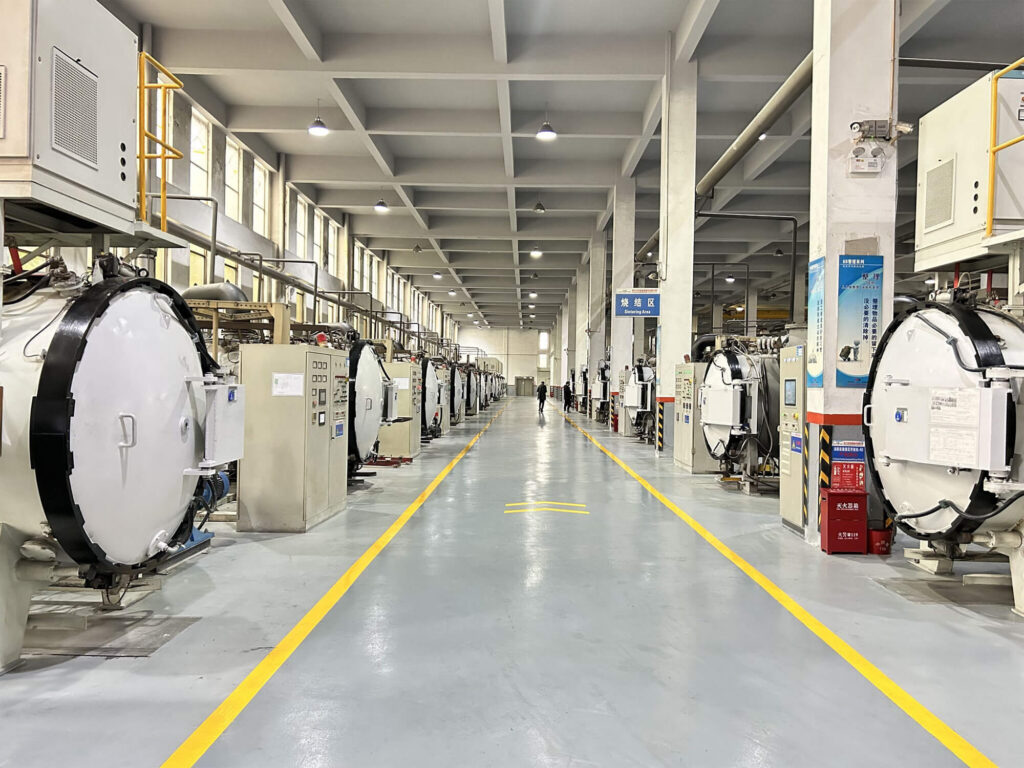
| Integrated production | In-house sintering, machining, plating, and QC — no outsourcing of critical steps |
| Raw material inventory | Strategic rare earth alloy reserves to buffer spot market volatility |
| Production flexibility | Accommodates prototype sampling (100 pcs) through mass orders (500,000+ pcs) |
| Delivery reliability | Confirmed lead times with penalty clauses available for framework contracts |
| Scalability | Capacity expansion plan visible (equipment investment, workforce) |
Large-scale integrated production also passes real cost advantages to buyers: amortized tooling, optimized sintering batch sizes, and reduced per-unit processing costs translate directly to competitive wholesale pricing without quality compromise.
What to verify: Request production capacity documentation — monthly output capacity, equipment list, and workforce size. Visit the factory if the order value justifies it.
4. Quality Management System: The Non-Negotiable Foundation
Magnetic performance, dimensional accuracy, coating integrity, temperature resistance, and structural stability all degrade without a rigorous quality management framework. Manufacturers lacking full-process quality control frequently ship defective batches — coating delamination, premature magnetic decay, dimensional drift — that only surface during your assembly or your customer’s field deployment.
A qualified neodymium magnet manufacturer implements quality control at four stages:
Stage 1 — Incoming Material Inspection
- Rare earth alloy composition analysis (ICP or XRF)
- Magnetic powder activity verification
- Supplier certification review
Stage 2 — In-Process Monitoring
- Sintering temperature profile logging per batch
- Pressing density consistency check
- Machining dimensional sampling per production lot
Stage 3 — Finished Product Testing
- Gauss meter / fluxmeter magnetic performance measurement
- CMM dimensional inspection to drawing tolerances
- Salt spray test (typically 48–96 hrs for Ni coating; 240+ hrs for epoxy)
- High-temperature endurance test per grade specification
Stage 4 — Outgoing Shipment Verification
- 100% visual inspection for coating defects
- Statistical sampling dimensional check
- Batch traceability label and full documentation package
Certifications required: ISO 9001:2015 quality management system; RoHS 2.0 / REACH compliance for EU and North American markets. IATF 16949 for automotive supply chain applications.
What to verify: Request the actual salt spray test reports and CMM inspection data from a recent production batch — not just the certification certificates.
5. Genuine Cost Performance: Beyond the Lowest Quote
Rare earth raw material pricing is broadly transparent across the NdFeB industry. When a supplier quotes significantly below market rates, one of three things is happening:
- Downgraded material grade — lower remanence Br, lower coercivity Hcj than specified
- Recycled or adulterated alloy — inconsistent magnetic performance, accelerated decay
- Undersized tolerances — dimensions within spec on samples, drifting on bulk batches
- Thin or non-compliant coating — passes initial inspection, fails under operating conditions
A credible neodymium magnet manufacturer maintains transparent pricing anchored to:
- Standard-grade virgin rare earth alloy (praseodymium-neodymium metal)
- Full specification tolerances as agreed
- Compliant coating thickness (Ni: typically 10–20μm; epoxy: 15–25μm)
- Honest yield management — scrap rate absorbed internally, not passed to buyers
Total cost of ownership is the correct comparison metric. High-quality magnets from a reputable supplier reduce assembly defect rates, extend component service life and minimize warranty and field replacement costs — consistently outperforming low-price alternatives on a 3–5 year cost horizon.
What to verify: Request material certificates (raw alloy lot traceability) and coating thickness test reports. Compare against spot prices for neodymium metal on Shanghai Metal Market.
6. Technical Support & After-Sales Service: The Partnership Differentiator
The best neodymium magnet manufacturer relationships operate as technical partnerships, not transactional supplier-buyer arrangements. In-house engineering teams at qualified manufacturers proactively contribute to your product development:
- Grade selection — recommending the optimal NdFeB grade for your operating temperature, flux requirement, and demagnetization risk
- Coating specification — matching surface treatment to your operating environment (humidity, chemicals, assembly process)
- Magnetization scheme — advising on post-assembly magnetization vs. pre-magnetized supply based on your handling capability
- Structural optimization — identifying geometry modifications that reduce material cost without sacrificing performance
- Application troubleshooting — diagnosing field failures and proposing corrective specifications
After-sales mechanisms matter equally. A reliable supplier maintains a structured response protocol for quality disputes — rapid sampling of retained lot specimens, root cause analysis within a defined timeframe, and replacement or credit resolution without prolonged negotiation.
What to verify: Pose a specific technical question during the quotation process (e.g., “What grade do you recommend for a 120°C continuous operating environment?”). The quality and specificity of the response reveal the depth of in-house engineering capability.
HUAJIN Magnets: Integrated NdFeB Manufacturer Since 2010
HUAJIN Magnets (Nanjing Huajin Magnet Co., Ltd.) operates as a vertically integrated neodymium magnet manufacturer covering the full production chain from raw alloy to finished magnetized components.
| Capability | HJ Magnets Specification |
|---|---|
| Factory area | 10,000 m² integrated facility |
| Team | 100+ employees, including the in-house engineering team |
| Product range | Sintered NdFeB N35–N52, temperature grades M/H/SH/UH/EH |
| Custom capability | Full drawing-based custom production; tolerances to ±0.02mm |
| OEM service | NDA, private mold, batch documentation, compliance certificates |
| Bulk capacity | Supports orders from 100 pcs sampling to 500,000+ pcs/month |
| Quality certifications | ISO 9001:2015; RoHS 2.0 / REACH compliant |
| Coatings available | Ni-Cu-Ni, Zn, epoxy, Au, parylene, PTFE |
| Markets served | Motors, EV, robotics, medical devices, sensors, consumer electronics |
Frequently Asked Questions
Q: What is the minimum order quantity for custom neodymium magnets? HJ Magnets accepts prototype sampling orders of 100 pieces for new custom specifications. Standard production MOQ for bulk neodymium magnets is typically 1,000–5,000 pieces, depending on geometry complexity and tooling requirements.
Q: How long does a custom NdFeB magnet order take from drawing to delivery? For new custom tooling: 15–25 business days, including mold fabrication, trial sintering, and inspection. For repeat orders with existing tooling: 7–15 business days, depending on order volume and coating specification.
Q: What surface coatings do you offer for corrosive environments? For high-humidity, acidic, or outdoor environments, we recommend epoxy coating (240+ hr salt spray), parylene conformal coating (medical/electronics grade), or PTFE coating (chemical resistance). Our engineering team will recommend the optimal coating for your specific operating conditions.
Q: Can you supply neodymium magnets compliant with REACH and RoHS for European export? Yes. All HJ Magnets standard production complies with RoHS 2.0 Directive 2011/65/EU and REACH Regulation EC 1907/2006. Full compliance documentation is provided with each shipment.
Q: How do I verify that the magnets I receive match the grade I ordered? Every HJ Magnets shipment includes a magnetic performance test report (remanence Br, coercivity Hcj, maximum energy product BHmax) measured on the production batch, plus a dimensional inspection report. Retained specimens from each lot are stored for 12 months for dispute resolution.
Conclusion
Selecting the right neodymium magnet manufacturer requires systematic evaluation across six dimensions: custom development capability, OEM processing maturity, wholesale and bulk supply capacity, rigorous quality management systems, genuine cost performance, and comprehensive technical and after-sales support.
Suppliers that excel across all six criteria deliver more than magnets — they deliver supply chain stability, predictable quality, and a technical partnership that strengthens your finished product’s competitiveness in the market.
HJ Magnets is built for exactly this role.
Contact our engineering team for a free application assessment →