Finding the right neodymium magnet manufacturer is one of the most consequential decisions a procurement team can make. The wrong supplier can mean delayed shipments, inconsistent pull force, or magnets that fail at operating temperature — all of which translate directly into production downtime or product recalls.
This guide walks you through exactly what to look for when sourcing bulk neodymium magnets, how to compare magnet grades, where to buy neodymium magnets for sale, and why the sourcing channel you choose matters as much as the magnet itself.
Why More Companies Are Buying Neodymium Magnets in Bulk
Demand for strong neodymium magnets has accelerated sharply across industries. Electric vehicle motors, industrial robotics, medical imaging equipment, renewable energy generators, and consumer electronics all depend on high-performance NdFeB magnets — and the supply requirements for each are growing.
Buying in bulk offers three clear advantages:
- Unit cost reduction. Factories quote significantly lower prices at volume thresholds of 500, 1,000, or 10,000 pieces. For assembly lines running daily, this margin difference is substantial.
- Supply chain stability. A committed bulk order gives manufacturers the lead time to allocate raw materials and schedule production, reducing the risk of stockouts during peak demand.
- Specification consistency. Bulk orders produced in a single batch — or from a single raw material lot — deliver far more consistent magnetic performance than split orders from different production runs.
For any company integrating magnets into a finished product, inconsistency is not a minor inconvenience. It is a quality defect. That is why choosing the right neodymium magnet manufacturer from the start matters more than any other factor.
What Makes a Reliable Neodymium Magnet Manufacturer?

Not every supplier calling itself a manufacturer has the infrastructure to reliably support bulk B2B orders. Here are the five dimensions that separate capable manufacturers from the rest.
Factory Experience
Years in production are a meaningful signal. A manufacturer with 10 or more years of NdFeB production history has encountered — and solved — the technical problems that cause batch failures: inconsistent sintering, coating adhesion failures, demagnetization under thermal stress, and dimensional drift across large runs.
Look for a factory that can provide customer references in your industry, not just a general product catalog.
ISO Certification
ISO 9001 certification is a baseline requirement, not a bonus. It confirms that a manufacturer has documented quality management systems, internal audit procedures, and corrective action protocols.
For applications in the medical, automotive, or aerospace sectors, ask specifically about ISO/TS 16949 or ISO 13485 compliance, depending on your end-use category.
Production Capacity
A manufacturer’s stated monthly output — typically expressed in tons of finished magnets — determines whether they can accommodate your order without compromising other customers’ timelines. Confirm this number against their equipment list: the number of sintering furnaces, pressing machines, and coating lines on-site is a more reliable indicator than a figure on a brochure.
Also, confirm whether they hold safety stock of common grades (N35, N42, N52) to fulfill reorders faster.
Quality Inspection
Reliable manufacturers perform multi-stage inspection, not just a final check. Key checkpoints include:
- Raw material assay: Confirming rare-earth composition (neodymium, dysprosium, boron ratio) before pressing
- Gauss measurement: Verifying magnetic flux density on finished pieces
- Dimensional inspection: CMM or optical measurement against your engineering drawing
- Salt spray and adhesion testing: Confirming coating integrity before shipment
Ask for a sample Inspection Report (IQC/OQC) and a material certificate with lot traceability before placing a full order.
Engineering Support
The best neodymium magnet manufacturers do not simply press magnets into a drawing. They advise on magnetization direction, grade selection for thermal environment, coating compatibility with your assembly adhesives, and tolerances that are achievable at scale without inflating unit cost.
Engineering support is especially critical when you are designing a new motor, sensor, or actuator. A manufacturer’s application engineers can often save weeks of prototype iteration.
How to Evaluate Strong Neodymium Magnets
Not all strong neodymium magnets perform the same way. Grade selection is the most technically sensitive decision in any bulk magnet procurement.
Grade: N35 to N55
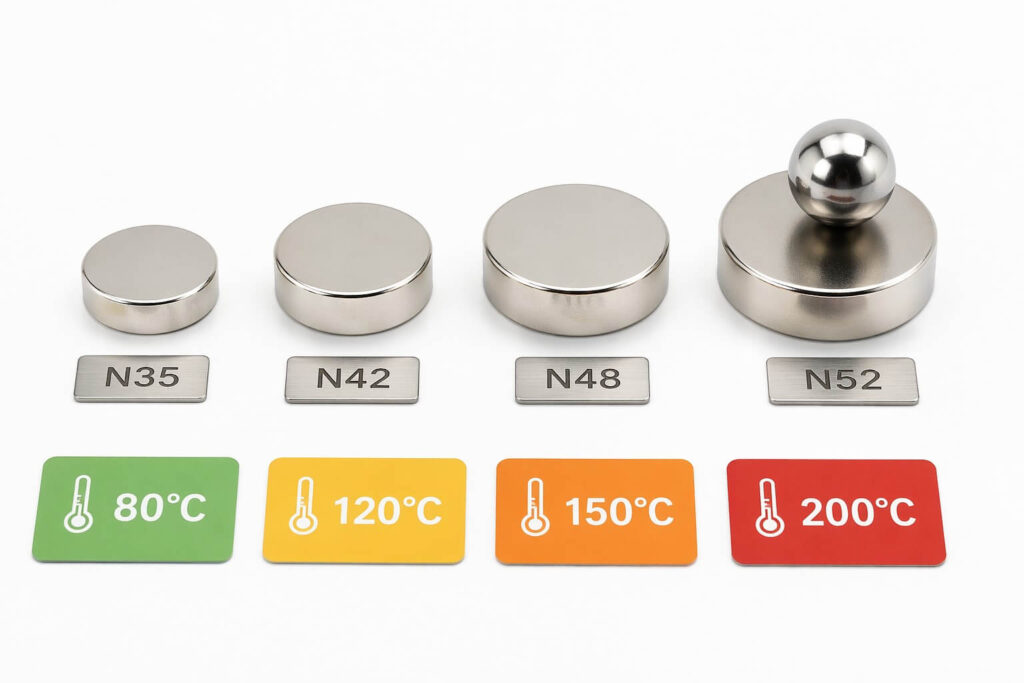
Neodymium magnets are classified by their maximum energy product, measured in Mega-Gauss-Oersteds (MGOe). The “N” number directly reflects this value.
| Grade | Energy Product (MGOe) | Typical Application |
|---|---|---|
| N35 | 33–36 | General holding fixtures, educational, and low-power sensors |
| N42 | 40–43 | Consumer electronics, speaker assemblies, craft magnets |
| N48 | 46–49 | Servo motors, robotics actuators, precision instruments |
| N52 | 50–53 | High-density motor rotors, aerospace, and medical devices |
Higher grade magnets deliver more pull force per unit volume — which means a smaller, lighter magnet can replace a larger, heavier one. This matters when weight and space are constrained, as they are in EV drivetrains and handheld medical devices.
Pull Force
Pull force is the maximum tensile force required to separate a magnet from a flat steel surface under direct contact. It is determined by grade, geometry, and contact surface quality.
Two magnets with the same grade but different thickness-to-diameter ratios will produce different pull forces. Always request pull force data specific to your exact dimensions, not general-grade data sheets.
Temperature Grade
The suffix letter after the N-grade indicates the magnet’s maximum operating temperature before irreversible demagnetization occurs:
| Suffix | Max Temperature |
|---|---|
| (none) / N | 80°C |
| M | 100°C |
| H | 120°C |
| SH | 150°C |
| UH | 180°C |
| EH | 200°C |
For motor and generator applications, selecting the wrong temperature grade is one of the most common — and most costly — specification errors. Confirm the thermal environment your magnets will operate in before finalizing grade selection.
Coating
The coating protects the magnet’s iron-rich core from corrosion. Standard and specialty options include:
| Coating | Best For |
|---|---|
| Nickel-Copper-Nickel (NiCuNi) | General industrial use, most common |
| Zinc (Zn) | Cost-sensitive applications, limited humidity |
| Epoxy | High humidity, chemical exposure environments |
| Gold | Electronics, aesthetic-critical assemblies |
| PTFE | Chemical and lab equipment (FDA-adjacent uses) |
Confirm that the coating thickness is specified in your engineering drawing and verified by your supplier’s QC report.
Where to Buy Neodymium Magnets for Sale
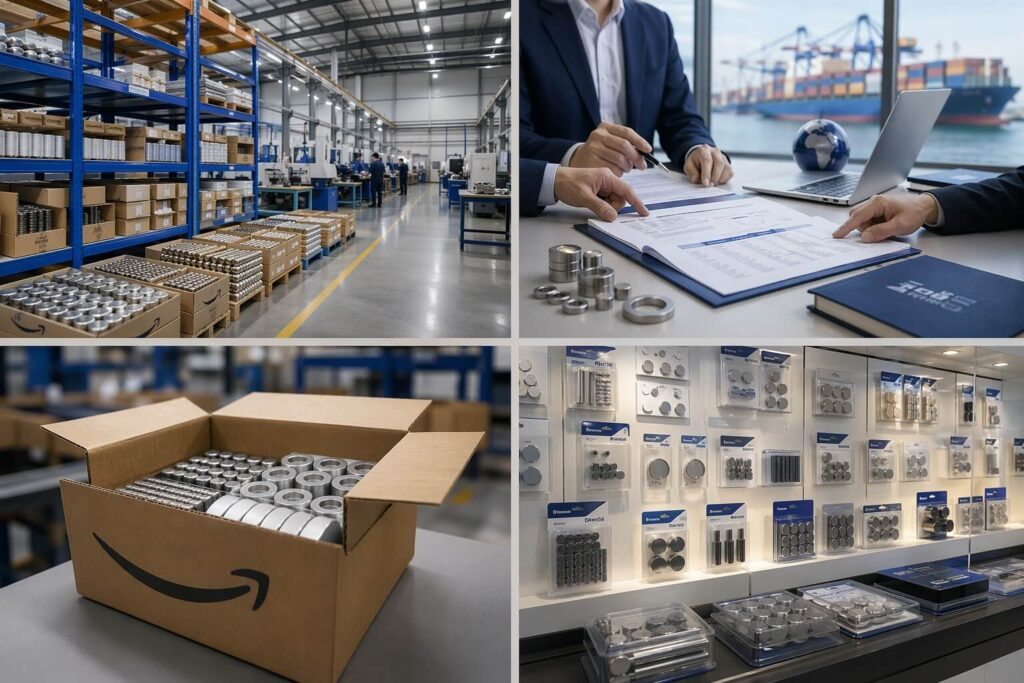
When searching for neodymium magnets for sale, buyers typically encounter four sourcing channels. Each has a different risk/benefit profile.
Factory Direct
Advantages:
- Lowest unit cost at volume
- Direct control over specifications, grades, and custom dimensions
- Access to factory engineers for application consultation
- Full traceability — raw material certificates, lot numbers, inspection reports
- Faster issue resolution (no intermediary delay)
Disadvantages:
- Minimum order quantities (MOQ) may be higher — typically 100–500 pieces per specification
- Lead times can range from 10 to 30 days for custom orders
- Requires due diligence on factory verification before the first order
Best for: B2B buyers sourcing 500+ pieces per SKU, OEM manufacturers, and engineering teams with custom specifications.
Trading Company
Advantages:
- Lower MOQ — can consolidate small orders across multiple SKUs
- Can source from multiple factories and offer a wider product range
Disadvantages:
- Additional markup (typically 15–30% above factory price)
- No direct access to production data or engineering support
- Quality consistency depends on which factory they use for a given order
Best for: Smaller distributors or buyers who need mixed-grade, low-volume assortments.
Amazon
Advantages:
- Instant availability, no lead time
- Easy returns and buyer protection
- Suitable for hobbyists, makers, and small-quantity testing
Disadvantages:
- Significantly higher per-unit cost (10–50× factory pricing at scale)
- No custom specifications — catalog sizes only
- No material certificates or lot traceability
- Unsuitable for any industrial or regulated application
Best for: Prototyping, educational use, and individual makers. Not appropriate for bulk procurement.
Distributor
Advantages:
- Local stock in-country, shorter lead time for reorders
- Technical support in your language and time zone
Disadvantages:
- Price premium over factory direct (typically 20–40%)
- Limited ability to accommodate custom specifications
- Stock depth may be insufficient for large-volume orders
Best for: Time-critical reorders of standard grades where lead time outweighs cost.
Summary:
| Channel | Unit Cost | MOQ | Custom Specs | Lead Time | Tech Support |
|---|---|---|---|---|---|
| Factory Direct | ✅ Lowest | Medium | ✅ Full | 10–30 days | ✅ Yes |
| Trading Company | ⚠️ Medium | Low | ⚠️ Limited | 15–25 days | ⚠️ Partial |
| Amazon | ❌ Highest | 1 pc | ❌ None | 1–3 days | ❌ None |
| Distributor | ⚠️ Medium-High | Low | ❌ Limited | 2–10 days | ⚠️ Partial |
For bulk procurement, factory direct is the only channel that delivers specification control, cost efficiency, and quality traceability simultaneously.
Why HJ Magnets
Nanjing Huajin Magnet Co., Ltd. — HJ Magnets — has supplied high-performance NdFeB and SmCo magnets to industrial buyers worldwide for over a decade. Here is what that means in practice for your procurement:
- Factory-direct pricing with no trading company markup — you deal directly with the production team
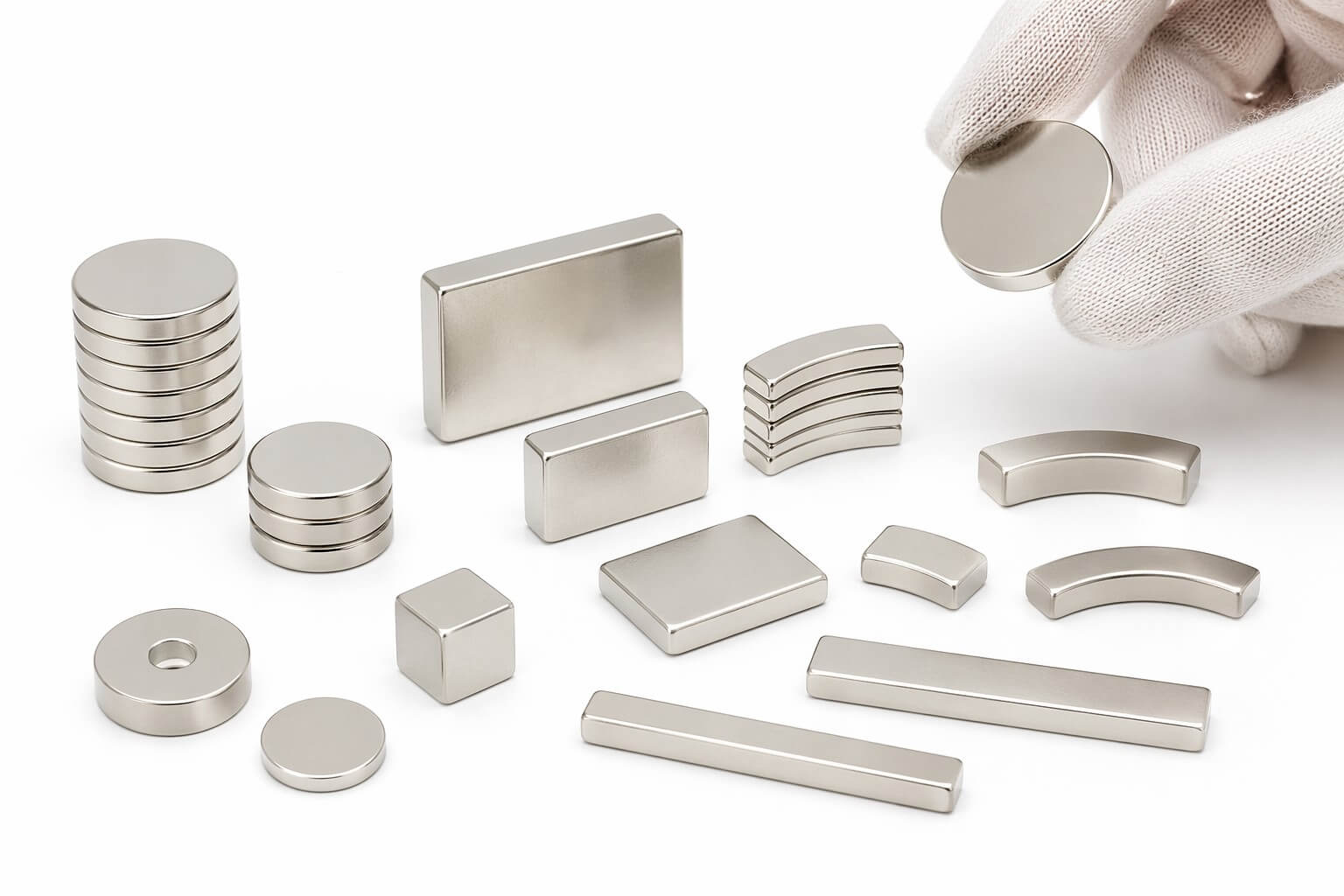
- Custom specifications accepted — any grade (N35 to N55), any shape (disc, block, ring, arc, irregular), any coating
- ISO 9001 certified quality management with multi-stage inspection and full lot traceability
- Engineering consultation included — our team reviews your drawing, recommends the optimal grade and magnetization direction, and flags potential assembly issues before you commit to a bulk order
- Competitive MOQ — available from 100 pieces, scalable to millions
- Proven B2B track record — serving motor manufacturers, robotics companies, medical device integrators, and industrial equipment OEMs across North America, Europe, and Asia-Pacific
Whether you need a standard N42 disc magnet in volume, a custom N52-SH arc segment for a PMSM rotor, or a magnetically assembled component ready for your production line, HJ Magnets has the factory capacity and technical expertise to deliver it consistently.
Ready to request a sample or quote?
Contact our engineering team with your specifications — grade, dimensions, coating, quantity, and delivery timeline — and we will respond with a detailed quotation and DFM (Design for Manufacturability) review within 24 hours.