Magnetic rods for use in the food industry are the frontline defense against ferrous contamination in modern food manufacturing. Whether your plant processes grain, dairy, sauces, or infant formula, selecting the correct food-grade magnetic rod directly determines whether your production line meets FDA, HACCP, and BRC food safety standards — and whether your finished product ever reaches a customer complaint or recall.
This guide from HJ Magnets — a NdFeB magnet manufacturer with over 15 years of industrial experience — walks through the five essential selection dimensions every food processing engineer and procurement manager must evaluate.
What Is a Magnetic Rod for Food Industry Use?
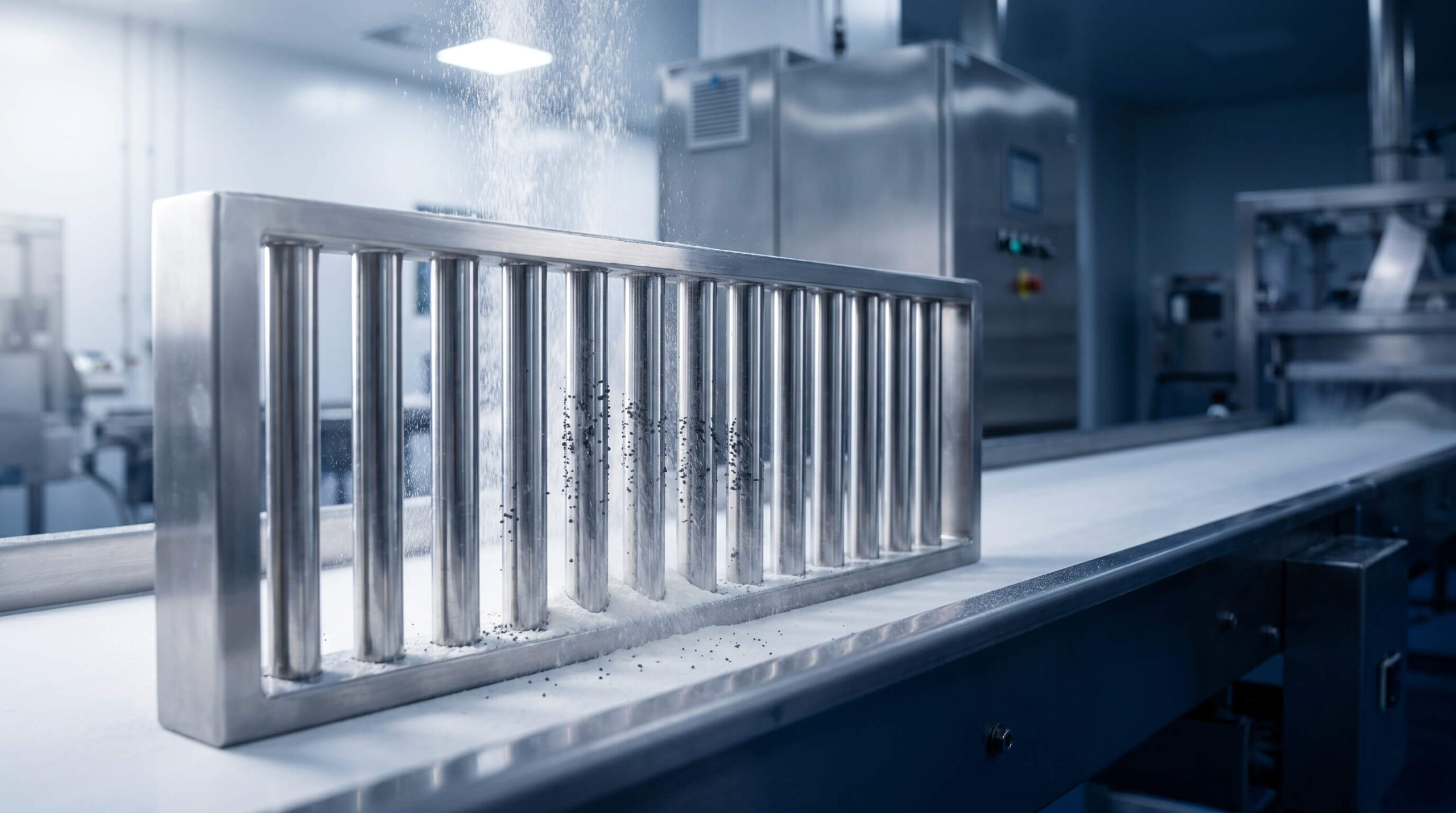
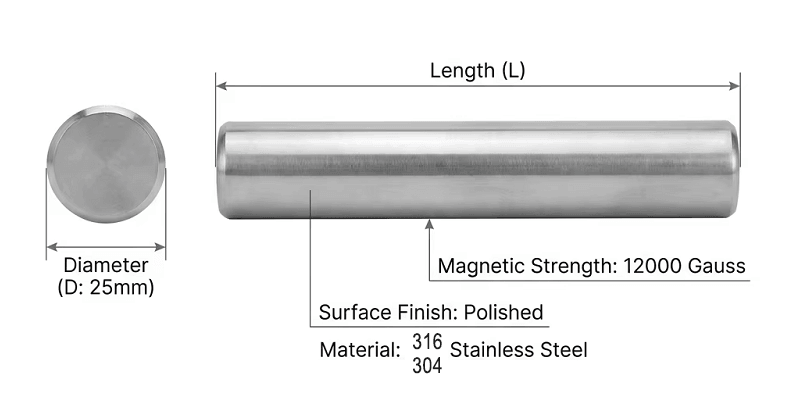
A food-grade magnetic rod (also called a magnetic filter bar or magnetic tube) is a cylindrical permanent-magnet device encased in a sanitary stainless-steel sleeve. Installed inside hoppers, pipelines, chutes, and drawer frames on food production lines, it generates a powerful magnetic field — typically ranging from 8,000 to 16,000 Gauss — that attracts and captures ferromagnetic particles before they contaminate finished food products.
Unlike conventional industrial magnetic rods, food-grade variants must comply with direct-contact food safety requirements:
- Sleeve material: food-certified 304 or 316L stainless steel
- Surface finish: Ra ≤ 0.8 μm mirror polish (no bacteria-harboring crevices)
- Sealing: fully welded, pressure-tight end caps to prevent internal corrosion
- Compliance: compatible with FDA 21 CFR, EU 1935/2004, HACCP, and BRC audit requirements
Five Key Criteria for Selecting a Food Industry Magnetic Rod
1. Magnetic Field Strength: Match Gauss Rating to Your Contamination Risk
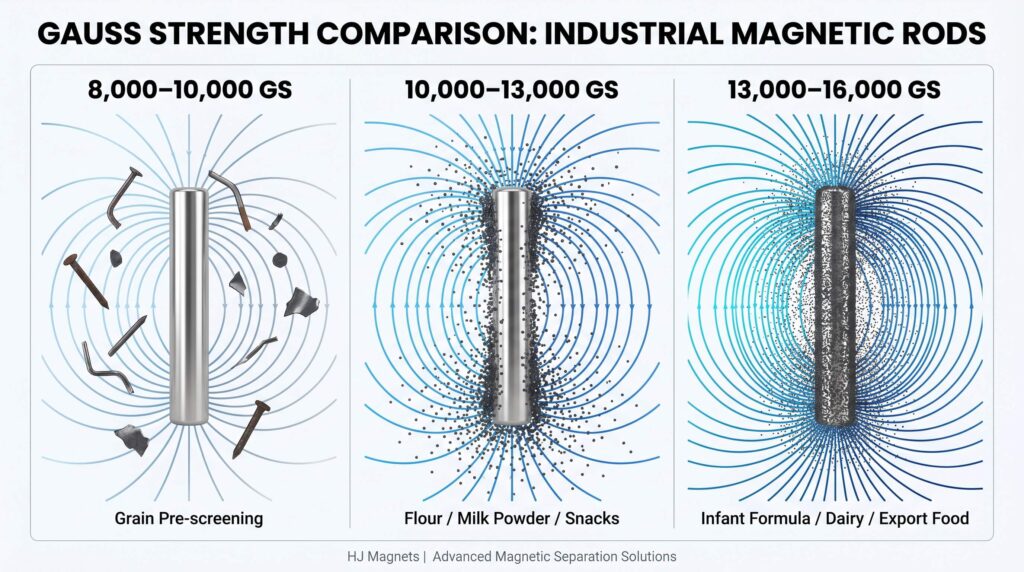
Magnetic field strength — measured in Gauss (GS) at the surface — is the single most important performance indicator for any food processing magnetic separator. The Gauss rating determines which particle sizes and types the rod can capture.
| Production Scenario | Recommended Gauss | Particle Capture Capability |
|---|---|---|
| Grain cleaning, nut pre-screening (rough filtration) | 8,000–10,000 GS | Iron nails, wire, large rust flakes (>1 mm) |
| Flour, starch, puffed snacks, milk powder (standard lines) | 10,000–13,000 GS | Fine iron particles & SS wear debris ≥ 0.1 mm |
| Infant formula, dairy, sterile beverages, export-grade food | 13,000–16,000 GS | Ultra-fine rust powder ≥ 0.05 mm; viscous fluids |
Key insight: Low-Gauss magnetic rods (below 8,000 GS) cannot capture ferromagnetic particles smaller than 0.1 mm. In grain flour, dairy powder, or sauce production, those invisible particles are exactly the contamination that triggers failed metal-detector checks and product recalls.
For most standardized food production lines, a surface magnetic strength of 10,000–13,000 GS delivers the best balance of capture efficiency, magnetic longevity, and total cost of ownership. High-grade NdFeB cores at this range maintain stable performance for 1–2 years in dry, normal-temperature environments without significant magnetic decay.
2. Tube Diameter & Length: Size the Rod to Your Material Flow
Tube diameter and effective length determine material flow smoothness, magnetic field coverage, and overall separation efficiency inside your food processing magnetic separator installation.
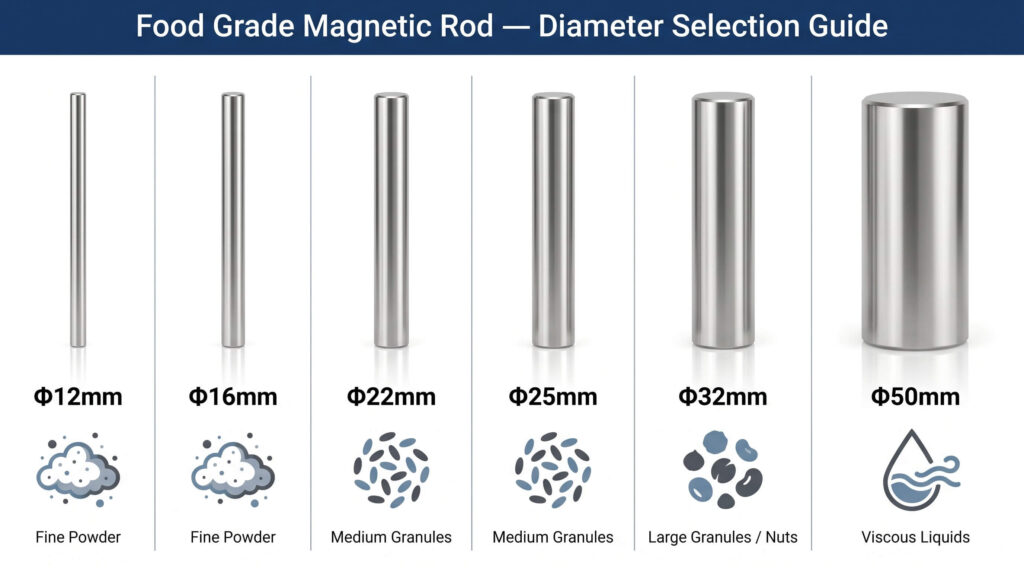
Diameter Selection by Material Type
| Material Type | Recommended Diameter | Typical Application |
|---|---|---|
| Fine powder: flour, milk powder, spice powder | Φ12 mm / Φ16 mm | Dense magnetic frames, small hoppers, and lab batching |
| Medium granules: rice, crushed corn, puffed particles | Φ22 mm / Φ25 mm | Drawer magnetic grids, pipeline filters |
| Large granules: whole grain, nuts, frozen block food | Φ32 mm / Φ38 mm / Φ50 mm | Raw grain discharge ports, large silo inlets |
| Liquids & viscous fluids: oil, jam, dairy slurry | Φ25 mm / Φ32 mm | In-line pipeline magnetic separators |
Oversizing the diameter in powder systems causes bridging and flow blockage. Undersizing in granule systems causes particle jamming and line stoppages. Always match rod diameter to your largest material particle and your pipeline’s nominal bore.
Length Selection
- Wide conveying channels and large-span flow zones → longer magnetic rods (custom lengths up to 1,200 mm available) to eliminate coverage blind spots
- Compact installations and short pipelines → standard lengths (100–600 mm) optimize magnetic energy density and reduce procurement cost
3. Sleeve Material: 304 vs. 316L Stainless Steel
The outer stainless steel sleeve is not merely a housing — it defines food safety compliance, corrosion resistance, and service life of every magnetic rod for food industry installation.
| High-acid environments (dairy, pickling, citrus), export lines, and pharmaceutical contact | Best For | Key Properties |
|---|---|---|
| 304 Stainless Steel | Standard dry food processing, general-purpose lines | Excellent corrosion resistance, smooth hygienic surface, non-toxic, cost-effective |
| 316L Stainless Steel | High-acid environments (dairy, pickling, citrus), export lines, pharmaceutical contact | Superior chloride corrosion resistance, withstands CIP/SIP chemical cleaning, meets EU & FDA contact standards |
Internal magnetic core quality is equally critical. Premium-grade NdFeB cores from virgin alloy (not recycled materials) maintain ≥95% of rated magnetic strength for 2+ years. Inferior recycled-alloy cores show measurable magnetic decay within 3–6 months, by which point micron-level iron dust is already passing through your separator undetected.
HJ Magnets uses N35–N52 sintered NdFeB cores with nickel-copper-nickel triple coating, fully enclosed inside seamlessly welded stainless steel tubes, eliminating any risk of inner corrosion or magnetic core contamination.
4. Environmental Compatibility: Match Rod Design to Workshop Conditions
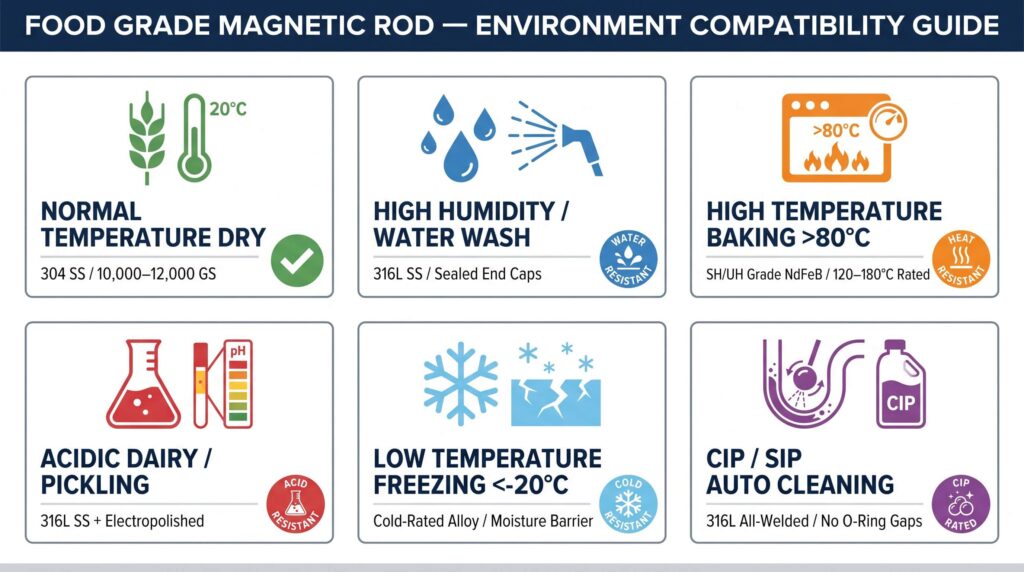
Food plants operate under vastly different environmental conditions that directly affect magnetic rod performance and longevity.
| Workshop Environment | Risk to Standard Rods | Required Specification |
|---|---|---|
| Normal-temperature dry grain workshop | Minimal — standard rods perform well | 304 SS, 10,000–12,000 GS |
| High-humidity / water-wash workshop | Surface rust, sleeve corrosion | 316L SS, fully sealed end caps |
| High-temperature baking/cooking line (>80°C) | Thermal demagnetization (Curie effect) | High-coercivity NdFeB grade (e.g., SH/UH series), rated to 120–180°C |
| Acidic dairy/pickling/fermentation | Chemical corrosion of sleeves | 316L SS + PTFE-coated or electropolished surface |
| Low-temperature quick-freeze workshop (<-20°C) | Brittleness risk, condensation corrosion | Cold-rated sleeve alloy, sealed moisture barrier |
| CIP/SIP automated cleaning systems | Chemical exposure during cleaning cycles | 316L SS, all-welded seam construction, no O-ring gaps |
For export-grade production lines that require routine CIP cleaning, only all-welded 316L stainless magnetic rods should be specified. O-ring sealed rods allow cleaning chemicals to penetrate between the sleeve and end cap, causing hidden internal corrosion that degrades both the sleeve and the NdFeB core.
5. Installation, Positioning & Daily Maintenance
Correct installation and standardized daily operation are prerequisites for maximizing the ROI of your food processing magnetic separator system.
Installation Best Practices
- Positioning: Install at the highest-risk contamination points — after grinding/milling stages, at hopper discharge, before filling and packaging
- Material contact angle: Position rods perpendicular to material flow for maximum surface contact time
- Mounting security: Firmly fix all rods and frames; vibration from conveying equipment will loosen unsecured rods over time
- Gentle handling: Never impact or drop magnetic rods during installation — internal NdFeB cores can crack under shock
Maintenance Schedule
| Task | Frequency |
|---|---|
| Visual inspection for attracted metal particles | Every 4–8 hours (high-throughput lines) |
| Manual cleaning / wiping with damp cloth | Daily |
| Manual cleaning / wiping with a damp cloth | Weekly or per production batch |
| Gauss meter field strength test | Monthly (document for HACCP records) |
| Full replacement assessment | Every 2–3 years (or when Gauss drops >15%) |
Temperature & Pressure Limits
- Do not expose NdFeB magnetic rods to temperatures exceeding the grade rating (standard N-grade: 80°C max; SH grade: 120°C; UH grade: 180°C)
- Do not exceed rated pipeline working pressure on in-line magnetic rods (typically 0.6–1.0 MPa for standard food-grade versions)
- Exceeding temperature limits causes permanent irreversible demagnetization — the rod will appear intact but will have lost 30–80% of its magnetic strength
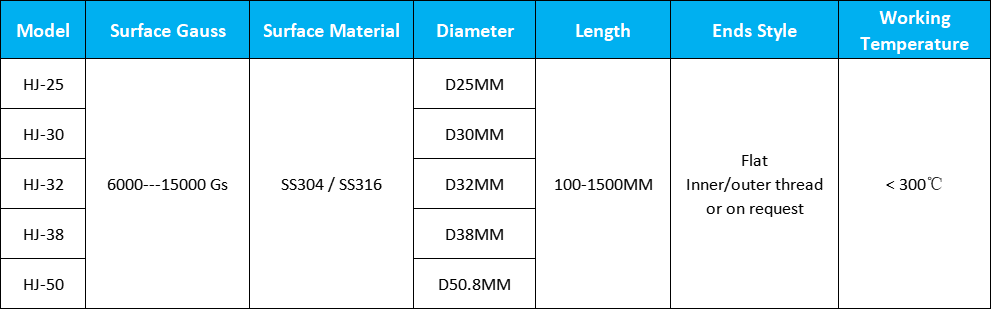
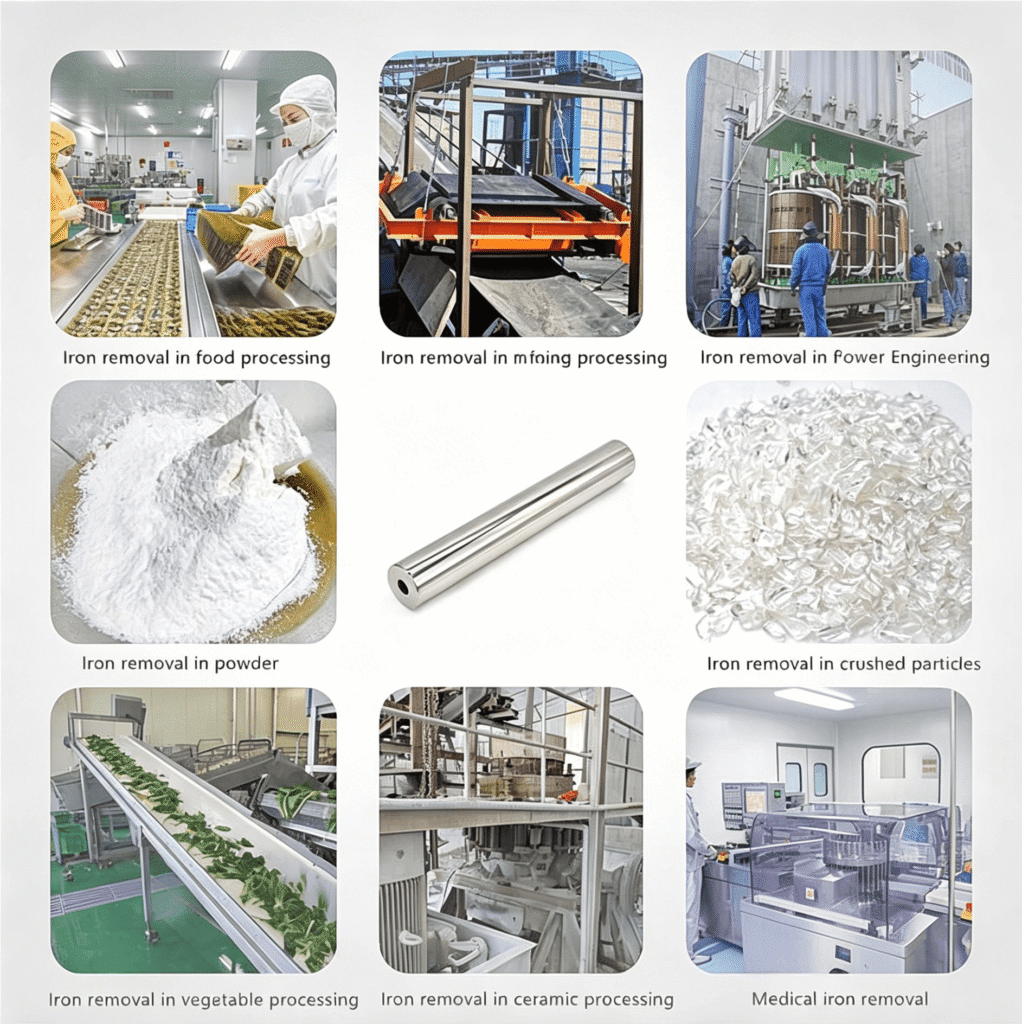
Huajin Magnets Food Grade Magnetic Rod Product Range
HJ Magnets manufactures a complete range of food-grade magnetic rods to cover every food processing application:
Frequently Asked Questions
Q: What Gauss rating do I need for HACCP compliance? HACCP does not mandate a specific Gauss value, but requires that your magnetic rod for food industry use is validated to capture the metallic contaminants present in your specific process. Most HACCP auditors accept 10,000–13,000 GS as the minimum for powdered food lines.
Q: Can I use one magnetic rod size for both powder and granule materials? No. Diameter must match the material particle size and flow rate. Using a narrow Φ16 mm rod for granular grain will cause bridging and line stoppages.
Q: How often should magnetic rods be replaced? High-quality NdFeB magnetic rods maintain >90% rated strength for 2–3 years under normal operating conditions. Replace when monthly Gauss meter testing shows >15% strength decline from the original rated value.
Q: What is the difference between 304 and 316L stainless magnetic rods? 304 SS offers excellent general corrosion resistance for most dry food environments. 316L SS adds molybdenum for chloride resistance, making it mandatory for acidic, saline, dairy and CIP-cleaned environments.
Conclusion
Selecting the right magnetic rod for food industry applications requires systematic evaluation across five dimensions: Gauss strength, tube diameter, sleeve material, environmental compatibility and installation discipline. Cutting corners on any of these criteria introduces invisible ferrous contamination risks that can trigger failed metal detector checks, regulatory penalties and product recalls.
HJ Magnets offers food-grade magnetic rod solutions engineered to meet the world’s most demanding food safety standards — from basic grain pre-cleaning to zero-tolerance infant formula and sterile beverage lines.
Contact our technical team for a free application assessment →