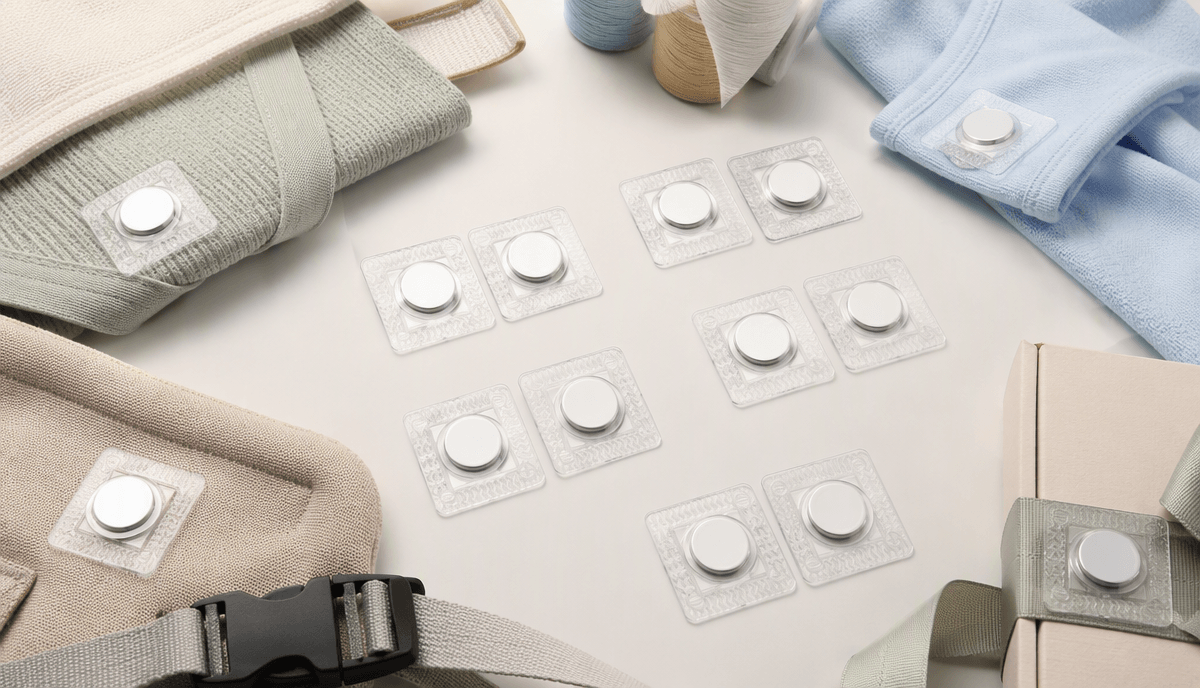
Custom button magnets are often associated with fashion accessories, handbags, and magnetic buttons for clothing. However, as magnet materials, coatings, and sealing technologies continue to improve, magnetic button applications are expanding far beyond apparel.
Today, more manufacturers are using custom button magnets to replace traditional snaps, zippers, plastic clips, and hook-and-loop fasteners. Compared with mechanical closures, magnetic buttons offer automatic alignment, one-handed operation, low wear, quiet closing, and long service life. These advantages make them especially valuable in industries where safety, convenience, durability, and product experience matter.
Below are five important non-fashion industries where custom magnetic buttons are becoming practical fastening solutions.
1. Medical and rehabilitation assistive devices
Industry challenges
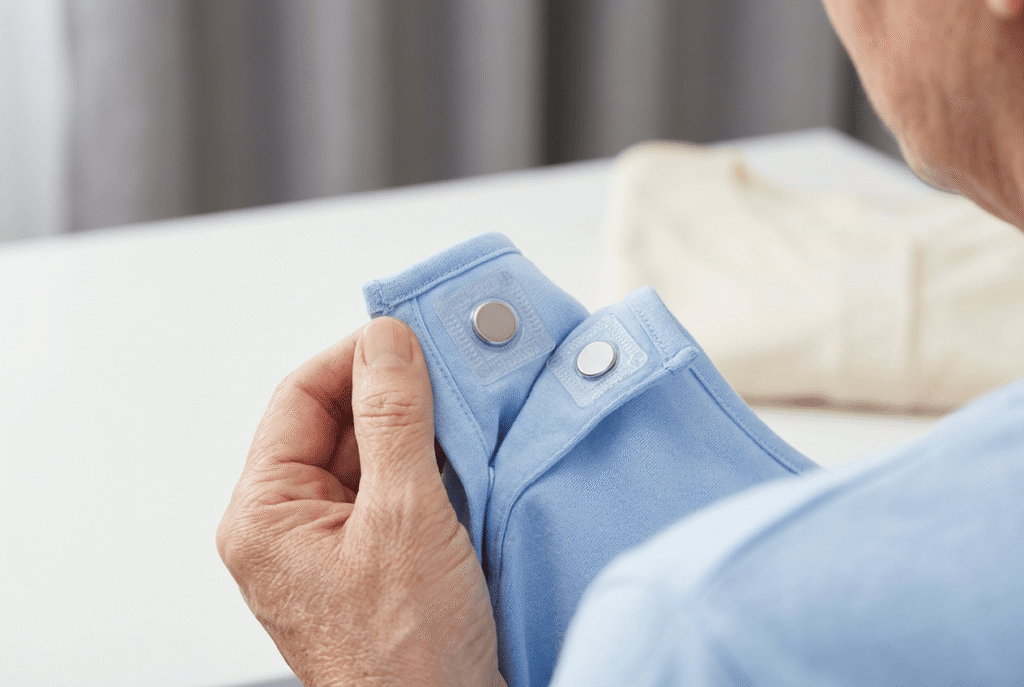
Medical and rehabilitation products often serve elderly users, arthritis patients, post-operation patients, and people with limited hand flexibility. For these users, traditional fasteners can be difficult to operate independently.
Small buttons require precise finger movement. Metal snaps may create pressure points or friction against the skin. Hook-and-loop fasteners can lose adhesion, collect lint, and become less reliable after repeated washing. In medical environments, hygiene and safety requirements are also higher. Exposed magnets may create risks around implanted medical devices, and low-quality magnetic accessories may corrode after frequent cleaning or alcohol disinfection.
Custom button magnet solution
Custom button magnets can be designed as sealed, smooth, and easy-open fastening components for rehabilitation clothing, braces, support belts, and assistive textile products. Their automatic attraction helps users close garments or devices with less hand strength and less precise alignment.
For medical-related products, the magnet should not be exposed directly. A sealed structure, smooth edge design, and controlled magnetic force are important for reducing skin irritation and improving safety during daily use.
Recommended selection standards
For many rehabilitation and assistive products, N35 neodymium magnets provide stable magnetic performance and help reduce long-term magnetic attenuation. Common diameters range from 10 mm to 14 mm, with single-button holding force typically between 0.6 kg and 1.0 kg. This range supports stable daily closure while still allowing users with weaker grip strength to open the fastener.
A Ni-Cu-Ni three-layer nickel coating improves rust and corrosion resistance. Finished magnetic button components can be designed for working temperatures from -20 degrees Celsius to 80 degrees Celsius and for more than 100,000 opening and closing cycles, depending on the final structure and application environment.
2. Infant and baby products
Industry challenges
Infant sleeping bags, onesies, bibs, and soft baby products require strict safety and comfort standards across every part. Traditional metal buttons and snaps may have hard edges that scratch delicate skin. Loose small parts can also create choking or swallowing risks.
Parents often need to dress babies quickly, sometimes in dim light or with one hand. Traditional buttons require accurate alignment and can slow down the process. Baby products also go through frequent washing and drying, so fasteners must resist rust, deformation, and surface deterioration.
Custom button magnet solution
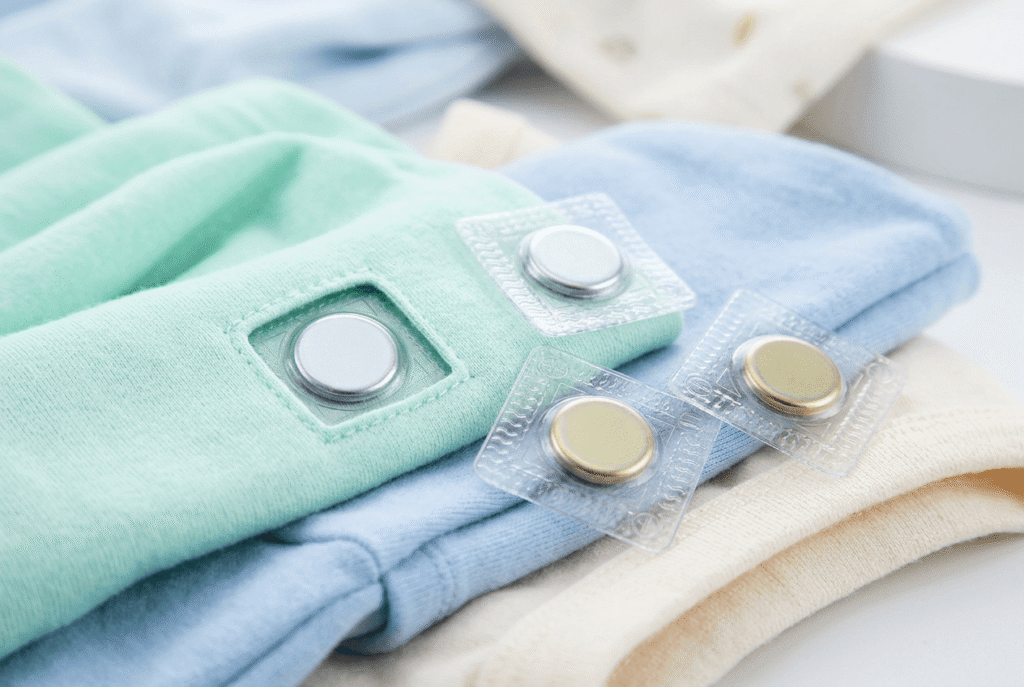
Baby-grade custom button magnets are usually designed with an integrated sealed structure. The magnet is enclosed inside a protective shell or textile-compatible housing, so there are no detachable small parts in normal use. Smooth edges help reduce scratching risk, while automatic magnetic alignment makes fastening faster and easier.
For infant products, material safety is critical. The structure should use baby-safe materials, avoid unpleasant odors, and prevent harmful heavy-metal precipitation. A reliable coating and sealing design also help the product withstand repeated washing and drying.
Recommended selection standards
N35 magnet materials are commonly used when stable performance and moderate magnetic force are required. Typical diameters range from 8 mm to 12 mm, with safe holding force around 0.5 kg to 0.8 kg. This force range helps prevent accidental loosening during normal baby movement while allowing parents to open the product safely during nursing or diaper changes.
Ni-Cu-Ni coating is generally preferred over low-cost galvanized layers. For higher safety requirements, an integrated injection-molded or sealed shell can help the finished button meet infant product testing requirements, including requirements related to detachable parts, surface smoothness, and restricted substances.
3. Adaptive and age-friendly clothing
Industry challenges
Adaptive clothing is designed for disabled users, hemiplegic patients, elderly people, and people living in rehabilitation centers or nursing homes. Traditional zippers and buttons often require fine motor control, which some users cannot manage independently.
For bedridden users, caregivers may need to dress and undress patients multiple times a day. Inefficient fasteners increase nursing workload and user discomfort. Ordinary magnetic buttons may also have uneven magnetic force or weak positioning, causing them to shift or loosen during movement while still being difficult to open quickly in emergencies.
Custom button magnet solution
Custom magnetic buttons for adaptive clothing can replace mechanical fasteners on shoulders, side seams, waist areas, and other functional positions. One-handed closing and quick-release structures help users dress more independently and allow caregivers to work more efficiently.
For applications that require positioning, multi-pole radial magnetization can be customized. This allows the magnetic button to attract and lock at a specific angle, reducing accidental displacement during walking, sitting, or repeated body movement.
Recommended selection standards
Factories often select N35 or N38 neodymium magnets for consistent magnetic flux and stable fastening. Common diameters range from 12 mm to 16 mm, with holding force around 0.8 kg to 1.2 kg. This balance supports both firm closure and easy operation.
Ni-Cu-Ni anti-corrosion coating, high-strength plastic sealing, and durable textile-compatible structures are recommended for products that need frequent washing or institutional laundry cycles. Axial magnetization and four-pole radial magnetization can be customized for anti-displacement and anti-loosening requirements.
4. High-end gifts and luxury packaging
Industry challenges
Luxury gift boxes, cosmetic packaging, perfume caps, and premium retail packaging require both appearance and user experience. Traditional plastic clips or spring closures can create harsh sounds, wear out over time, or cause poor box closure after repeated use.
Mechanical fasteners also take up extra space, which conflicts with minimalist and thin packaging design trends. In perfume, aromatherapy, and cosmetic packaging, volatile alcohol and humid air may corrode ordinary magnets, leading to rust, surface whitening, or reduced magnetic performance.
Custom button magnet solution
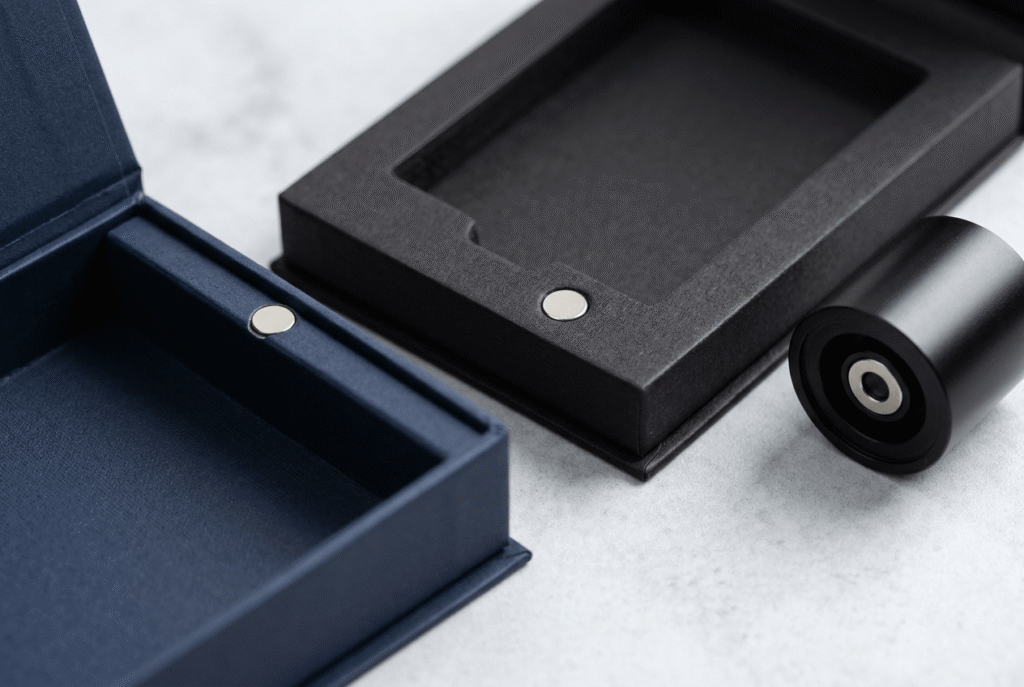
High-end packaging often uses ultra-thin disc magnets, ring magnets, or custom button magnets without bulky plastic sealing. These magnets can be embedded into pre-reserved grooves in paper boxes, wooden boxes, rigid gift boxes, or perfume caps.
Magnetic closing creates a soft, quiet, and premium hand feel. It also supports a cleaner appearance because the fastening structure can be hidden inside the packaging material. With proper coating, custom magnets can resist humidity and alcohol exposure better than ordinary unprotected magnets.
Recommended selection standards
N35 magnets are a practical choice for packaging applications because they provide mild and stable suction without creating excessive collision noise. Common sizes include diameters from 10 mm to 20 mm and thicknesses from 2 mm to 3 mm.
For perfume caps and premium gift boxes, ring magnets such as OD24 x ID20 x 2.2 mm can be customized according to the assembly design. Mirror-polished Ni-Cu-Ni three-layer nickel coating improves corrosion resistance and appearance. Tight dimensional tolerance, such as +/-0.05 mm when required, helps ensure stable assembly without shaking or deviation.
5. PET functional supplies
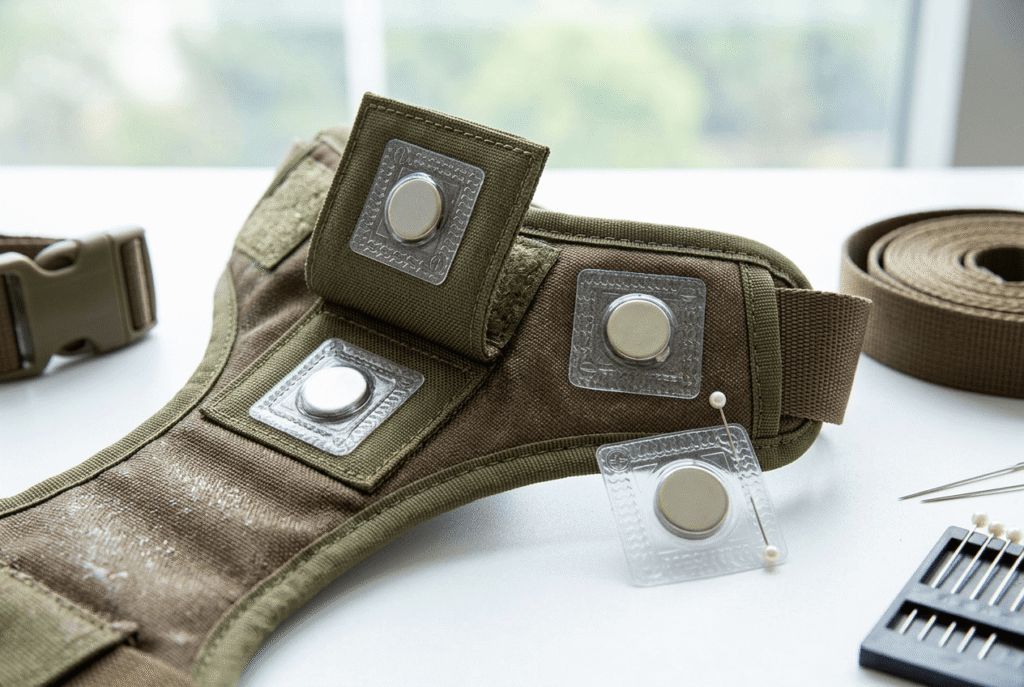
Industry challenges
Pet clothing, harnesses, protective sleeves, and outdoor pet accessories face demanding use conditions. Pets may twist, struggle, bite, or chew during dressing. Traditional alignment fasteners are often slow and inconvenient in these situations.
Exposed magnets may break, fall off, or create ingestion risks if the structure is not properly sealed. Pet products also face frequent washing, outdoor sunlight, rain, and dirt. Poor-quality magnets can rust or lose performance quickly. If the magnetic force is not controlled properly, the product may either loosen too easily or create uncomfortable pressure around the neck or body.
Custom button magnet solution
Pet-grade magnetic buttons usually use thickened, bite-resistant, fully sealed plastic shells. The shell protects the internal magnet from biting, tearing, moisture, and outdoor exposure. Automatic alignment allows pet owners to fasten or remove the product with one hand, even when the pet is restless.
A weather-resistant coating and sealed structure help the magnetic button maintain stable performance after washing, rain exposure, and regular outdoor use.
Recommended selection standards
N35 magnet materials are suitable for stable fastening under vibration and movement. Common diameters range from 10 mm to 14 mm, with holding force around 0.6 kg to 1.0 kg. This range helps avoid both excessive compression and accidental loosening.
A Ni-Cu-Ni anti-corrosion coating combined with a thickened wear-resistant plastic shell provides better water resistance, bite resistance, and weather resistance. An integrated sealing structure helps block moisture and reduce the risk of internal magnet oxidation.
How to choose the right custom button magnets
Different industries require different magnetic button designs. Buyers should not choose only by size or price. The following factors are more important for stable mass production:
- Magnet grade: N35 is suitable for many general fastening applications, while N38 can be considered when stronger magnetic performance is required.
- Holding force: The magnetic force should match the user group and application. Baby products and medical assistive products usually require safer, easier opening, while adaptive clothing may require stronger positioning.
- Coating: Ni-Cu-Ni coating improves corrosion resistance and is preferred over low-cost galvanized coatings for many long-term use scenarios.
- Sealing structure: Fully sealed plastic shells or injection-molded structures are recommended for baby products, pet supplies, and medical-related products.
- Magnetization direction: Axial magnetization, radial magnetization, and multi-pole designs can be customized for alignment, positioning, and anti-displacement needs.
- Dimensional tolerance: Packaging and assembly applications often require tighter tolerances to ensure smooth installation and a consistent closing feel.
Conclusion
Custom button magnets and magnetic buttons for clothing are no longer limited to fashion applications. They now provide practical fastening solutions for medical rehabilitation, infant safety products, adaptive apparel, luxury packaging, and pet supplies.
Each industry has different requirements for magnetic stability, safety, corrosion resistance, sealing, and holding force. Compared with traditional snaps, zippers, clips, and hook-and-loop fasteners, magnetic buttons offer easier operation, reduced mechanical wear, stronger customization options, and a more refined user experience.
HJ Magnet provides customized magnetic button solutions covering size, holding force, magnetization direction, coating, sealing structure, and assembly design. If you need custom button magnets for a specific product application, our team can help evaluate the appropriate material, structure, and magnetic performance for your project.