Why Humanoid Robots Need High-Performance Magnets
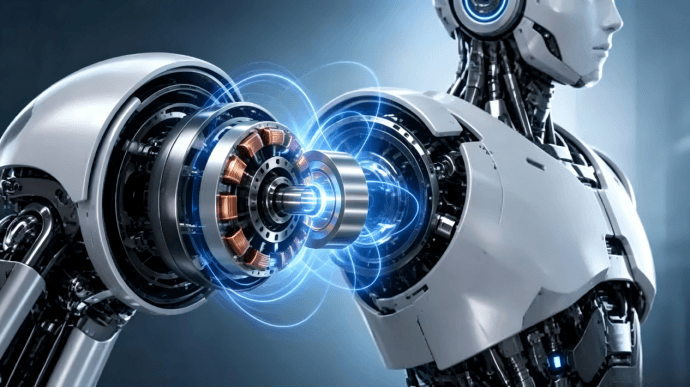
Neodymium magnets for humanoid robots have become essential components in modern robot drive systems.
Humanoid robots combine artificial intelligence with advanced mechanical design. Their joints require motors that deliver high torque, fast response, and precise control. The permanent magnet inside the motor directly affects joint power, robot weight, energy efficiency, and motion flexibility.
To achieve human-like movement, robot manufacturers need motors with:
- High power density
- Fast dynamic response
- Compact size
- Low weight
- High energy efficiency
These requirements place strict demands on permanent magnet materials.
Why NdFeB Magnets Dominate Robot Motors
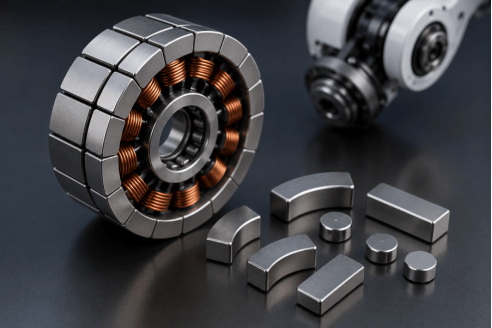
Manufacturers widely use neodymium iron boron (NdFeB) magnets in robot joint motors and servo systems.
NdFeB magnets offer the highest magnetic energy product among commercially available magnets. They also provide excellent cost performance. These advantages make them the preferred choice for humanoid robot servo motors.
In robot joints, high-performance NdFeB magnets help engineers:
- Miniaturize servo motors
- Reduce motor weight
- Increase torque output
- Improve response speed
- Enhance motion precision
The Growing Demand for Robot Magnets
Industry data shows that servo motors account for about 20% of a robot’s total cost. Permanent magnets represent nearly half of the servo motor cost.
As humanoid robots become more complex, magnet demand continues to rise.
For example:
- Tesla Optimus uses more than 28 degrees of freedom.
- Xiaomi CyberOne uses about 21 degrees of freedom.
- A single humanoid robot may contain 40 or more motors.
Industry estimates suggest that:
- Each humanoid robot requires about 4 kg of NdFeB magnets.
- Each large industrial robot requires about 25 kg of NdFeB magnets.
Why Manufacturers Choose NdFeB Over SmCo
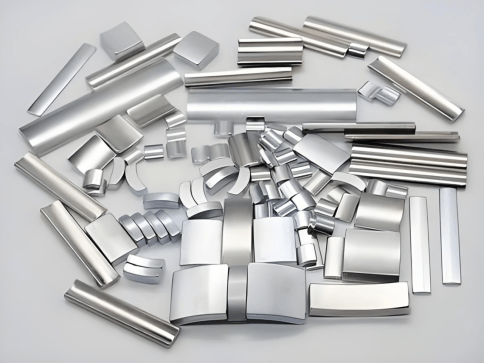
NdFeB magnets provide roughly twice the magnetic performance of samarium cobalt (SmCo) magnets in many applications. They also cost less.
These advantages make NdFeB the most widely used rare-earth permanent magnet material in the world.
Robot manufacturers choose NdFeB because it offers:
- High remanence
- High coercivity
- Fast motor response
- Stable operation
- Custom magnet shapes
- Flexible magnetization directions
These features help engineers design compact and complex robot joints.
Temperature Resistance and Reliability
Robot motors continue to become smaller and more powerful. As torque density increases, magnets must operate under higher temperatures.
Manufacturers now improve NdFeB magnets through grain boundary diffusion technology. This process increases coercivity and thermal stability while reducing heavy rare-earth usage by more than 50%.
Future high-temperature NdFeB magnets will likely maintain strong magnetic performance even under demanding robot operating conditions.
Corrosion Protection
NdFeB materials can oxidize and corrode if left unprotected. Manufacturers usually apply protective coatings such as:
- Zinc plating
- Ni-Cu-Ni plating
- Epoxy coating
These coatings improve durability and extend service life in robot applications.
Cost Advantages for Large-Scale Production
NdFeB magnets use iron and light rare-earth neodymium as their main raw materials. These materials remain more economical than many alternative magnetic materials.
Large-scale manufacturing has also become highly mature. As a result, NdFeB magnets offer significant cost advantages for mass-produced robots.
Why NdFeB Will Remain the Mainstream Choice
For the foreseeable future, neodymium magnets for humanoid robots will continue to dominate the market.
Even as robot performance requirements increase, manufacturers can improve NdFeB magnets through:
- Formula optimization
- Better coatings
- Higher temperature grades
- Advanced microstructure design
Because of their unmatched performance-to-cost ratio, NdFeB magnets will remain the preferred solution for humanoid robot drive systems, servo motors, and advanced robotics applications.